Are You Sensitive or Avoidant?

I promised a couple entries ago (link: Personality Styles vs Disorders, part 1) that I would be providing additional information about the differentiation between personality styles and personality disorders with consideration for the idea that personality exists on a continuum. First up: “Sensitive” as a personality style.

A person identifying as sensitive may have some or all of the following traits and individualized needs:

  • Familiarity: a preference for the “known”; habit, routine and overall predictability are sources of comfort
  • Concern: a significant care for how others perceive them
  • Circumspection/carefulness/watchfulness: avoidance of making quick judgments and a tendency toward deliberate and thought-out behavior
  • Politeness: heightened awareness of demonstrating social restraint and maintaining composure
  • Role: a need to know what is expected of them (predictability) and how they are intended to relate to others in the context of vocation, leisure and interpersonally
  • Privacy: hesitation when sharing intimate feelings with others despite having an established connection  (Oldham & Morris 1995)

While the personality traits of a Sensitive individual may not be significantly limiting, they do likely impact the person and his or her relationships, work habits and social behaviors.

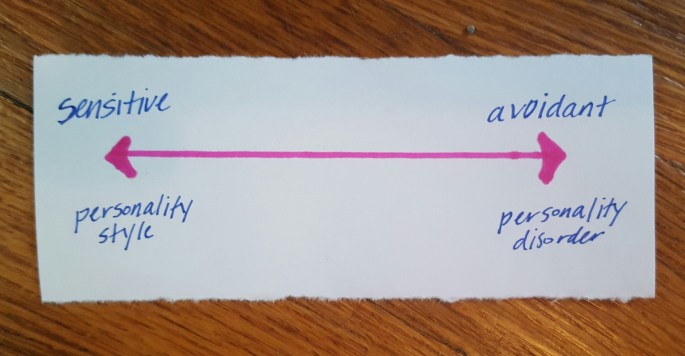
On the opposite, or more extreme, end of the “sensitivity spectrum” is Avoidant Personality Disorder.

20160808_161240.jpg

The chart below features common traits for a person with Sensitive Personality type with corresponding criteria that characterizes Avoidant Personality Disorder. Notice how the Avoidant descriptions on the right side are more intense and potentially pathological versions (ICD-10, 1992).

Sensitive Avoidant
Prefers familiarity Persistent, pervasive feelings of tension and apprehension
Concern for opinion of others Belief he/she is personally unappealing or inferior to others
Carefully avoids making judgments Excessive, often debilitating worry that one will be criticized and rejected in social situations
Politeness/social constraint Frequent avoidance of social encounters for fear of not being accepted or liked
Role (prefers to know what’s expected of them) Intense panic/nervousness when expectations for role or behavior aren’t clear
Prefers keeping feelings and concerns private Avoidance of intimacy and close personal relationships due to fear of rejection

Oldham, J. M., Morris, L. B., & Oldham, J. M. (1995). The new personality self-portrait: Why you think, work, love, and act the way you do. New York: Bantam Books.

The ICD-10 classification of mental and behavioural disorders: Clinical descriptions and diagnostic guidelines. (1992). Geneva: World Health Organization.

Personality Styles vs Disorders, part 1

Diagnosis of mental disorders can be helpful in providing a systematic way to better understand an individual and select treatment approaches specifically tailored to meet his or her needs. In the context of managed care, an accurate mental health diagnosis is necessary to justify the provision of services by insurance companies over the short or long term. A diagnosis creates uniformity among clinicians and medical providers working with a particular patient, ideally increasing the likelihood that treatment will occur on a continuum.

But diagnosing an individual is a complicated process–despite the continual revision and updating of the classification processes for diagnosis (DSM-5, ICD-10, etc), there exists room for error or misinterpretation of symptoms. As a clinician with diagnostic capabilities I encounter clients who have received a mental health diagnosis that they allow to define them. Not to mention, each person in the world was created uniquely and it’s impossible to utilize a carbon-copy/tailor-made treatment approach for one person that would be 100% appropriate for another.

From the beginning of my career I’ve enjoyed utilizing Personality Style inventories as a tool for understanding clients (as well as loved ones). Below is an image from New Personality Self-Portrait, Why You Think, Work, Love, and Act the Way You Do by John M. Oldham and Lois B. Morris. This text was used in a graduate course I took years back. The link I’ve included in this paragraph directs readers to a personality inventory that takes a few minutes to complete.

The Personality Style/Personality Disorder Continuum chart illustrates the notion that personality style exists on one end of a spectrum, and a corresponding personality disorder exists on the extreme end of the same spectrum. For example, an individual with a style of Vigilant may be watchful and aware of his or her surroundings; however, hyper-vigilance may indicate disordered functioning, in this case Paranoid Personality Disorder traits.

New Doc 12


Please stay tuned for additional information about each of the personality styles and how each can be used in treatment and to better understand how we function in relationships.


Oldham, J. M., Morris, L. B., & Oldham, J. M. (1995). The new personality self-portrait: Why you think, work, love, and act the way you do. New York: Bantam Books.

High-Functioning Anxiety: Slipping Under the “Anxiety Radar”, Perfectionism

High Functioning Anxiety

In my previous entry, I wrote about anxiety–pros and cons, types, and goal-setting for symptom management. I currently have therapy clients, family members, and friends in the midst of “seasons of transition” (moving, pregnancy, beginning a new job, starting college, etc.), and ANXIETY is a hot topic as a result.

Below is the link to an article from The Mighty, a resource outlining the everyday struggles and triumphs of people living with disability, mental illness, and/or chronic illness. The report features High Functioning Anxiety–a subcategory of anxiety.

Compared to other types, high-functioning anxiety (HFA, for the sake of my slow typing) is a different ballgame: often it’s undetected by parents, teachers, and peers as the individual can be high-achieving, academically successful, have above-average social skills, and maintain consistent employment.

I’ve had the opportunity to work with a variety of clients I would place into this category–I love working with HFA clients to learn how unique perspectives in achievement and life add to the person’s present level of functioning. In addition, HFA individuals are generally highly invested clients on my caseload and very motivated to work during time dedicated to therapy.

Check the article out for yourself:

http://themighty.com/2016/06/living-with-high-functioning-and-hidden-anxiety/

Opportunity: The Bridge

I love the concept of bridges. Bridges are designed to bear great weight, weather conditions, and can span great distances between one piece of land to the next.

Bridges can pose a great threat as an imposing structure; however, they can also serve as a powerful symbol of connection, transition, and growth. 

A person overwhelmed with his or her circumstances may view a bridge as an obstacle rather than an opportunity. As a professional counselor, my role is to help clients to view their circumstances in a different light over time–to accept and commit to the idea that throughout life we make a series of decisions about who or where we want to be.

If crossing a bridge is intimidating and full of “unknowns”, I would love to begin a counseling journey with you. I’ve decided to feature the image below as a symbol of my counseling practice, and hope that we can join forces to cross life’s bridges together.

For more information, please contact me HERE.

cropped-GGB-baker-beach-e1546382832930

Love Languages

Good morning.

In my work as an in-home therapist, it isn’t often that I get to administer tests, personality inventories and the like.  I frequently encounter “therapeutic fires” when I arrive at a home, i.e. a parent expresses frustration for a current family issue that we must address in the moment. No time for tests, Rychel! Graduate school provided a plethora of these measures–I miss utilizing them to serve others.

Fortunately, over the years in therapy practice I’ve continued to employ inventories to learn more about myself and others in relationships. I suppose it’s a form of self-care, to understand ourselves as helpers in order to better serve others. We’ve all encountered (or have been bombarded by) personality quizzes through social media, which I tend to take with a grain of salt (unless I’m having a particularly challenging day, then I use these as an escape, let’s be honest!).

My personal favorite, and particularly non-daunting, inventory for personal evaluation is the Love Language Profile, which can be found here. The linked website provides information on the five love languages (words of affirmation, acts of service, giving gifts, quality time and physical touch).

Personally, I’ve been able to apply my understanding of my Love Language profile to romantic relationships and friendships alike–any relationship that is intended to be dynamic and long-term. I find that not only does this inventory educate an individual on how to express love for others emotionally; understanding one’s primary love language(s) can provide dialogue within the context of a relationship to express one’s needs for receiving love.

If you haven’t used this tool for yourself, loved ones, clients, etc…I encourage you to do so!

Time for clients and paperwork. Happy Monday!

RJ